

The Episcopal Church needs a spiritual renewal that is not, and could not be, on the legislative agenda at the General Convention. Our leaders have gathered in Baltimore to conduct a mountain of business: the construction of budgets, canons, programs, and more, moral documents that will impact lives for years to come. But this business is meaningless if we are not centered in Jesus. We will accomplish far less, far more callously, if we neglect our interior spiritual lives. However, the inverse is also true. We will accomplish far more walking with Jesus than we could possibly imagine.
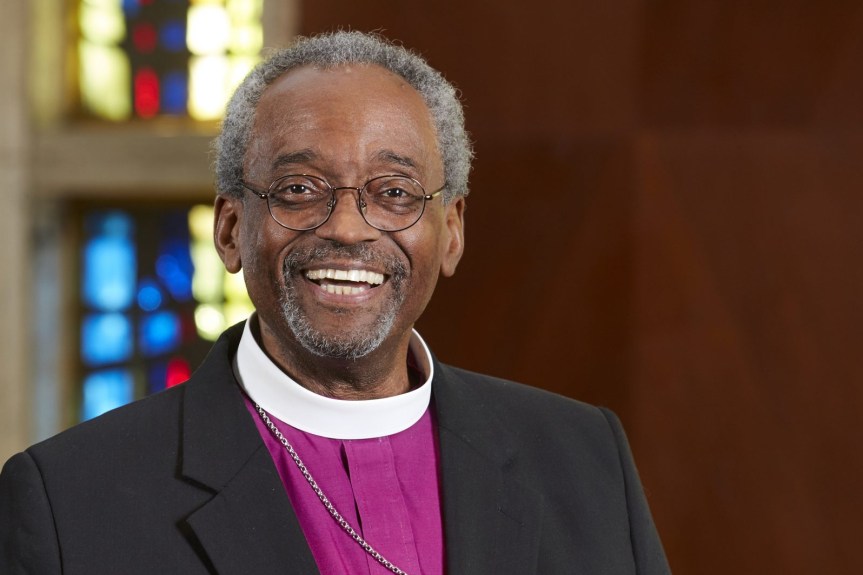
Presiding Bishop Michael Curry preached in pre-recorded fashion to two legislative houses taking simultaneous Eucharists in separate rooms. This was not a style we would have predicted in 2018, but it is one we have become all too familiar with over the course of the pandemic. He opened his sermon with an acknowledgement of this strangeness, feelings that echo the “diaspora, disorientation, dislocation” experienced by the prophet Jeremiah.
Bishop Curry named the challenges we now face, many of which were not on the agenda as we left the previous general convention. The global pandemic and online worship, a racial reckoning, addressing indigenous boarding schools, the rise of hate groups and domestic terrorism, the continued decline of organized religion, war in Ukraine, January 6th, and mass shootings: a list of challenges weighing heavily upon all in attendance as General Convention begins. An unspoken question hung in the air: what are we to do, exhausted and disoriented?
“Look to the rock from which you were hewn,” Bishop Curry quoted from Isaiah 51. Look to Abraham and Sarah; look to Jesus.
Before the complicated business of General Convention commenced in earnest, Bishop Curry gave a simple call to action: center on Jesus. This is a welcome word. We are in need of deep spiritual rejuvenation if we are to do the work to which the Holy Spirit leads us.
Bishop Curry also identified another type of challenge: not merely the work ahead, but the way in which we must accomplish that work. He cited a study commissioned by the Episcopal Church that identified how non-Christians in the United States describe Christians. Participants used words like hypocrisy, judgemental, self-righteousness, arrogance, and racism to describe Christians. While these results are predictable, they are also convicting. There is a gap, as Bishop Curry rightly pointed out, between Jesus and his followers. This gap is a stumbling block to mission and evangelism.
In answer to this gap, Bishop Curry established a direct line between the bedrock of internal spiritual practices as the foundation for outward work to follow. He shared two incoming initiatives: spiritual practice resources including a 9-week small group curriculum called “Centered,” and a coordinated evangelism campaign to take place on social media. His implication is clear: we must center Jesus in our lives, as individuals and faith communities, if we are to ask others to do the same.
Bishop Curry closed with a hymn:
My hope is built on nothing less
Than Jesus’ blood and righteousness
I dare not trust the sweetest frame
But wholly lean on Jesus’ name
On Christ the solid rock I stand
All other ground is sinking sand
All other ground is sinking sand
Throughout General Convention and when we return to ministries across the globe, let us remember this message. The strength we need to face the challenges of our day is at our fingertips: Jesus. He calls us to unselfish, sacrificial love. To hear this call, we must de-center ourselves and re-center Him. Let us pray together for spiritual renewal.
 The Episcopal Herald