

Why are we here? General Convention is churning through essential business, releasing hundreds of resolutions upon delegates and bishops with minimal opportunity for debate. As the torrent of legislation passes over their desks, it would be understandable to maintain an impersonal, efficient candor. Holding floor space is impossible for every item; after all, we have room only for the most essential business.
Enter the Holy Spirit.
The essential business of our church’s governance cannot be contained in resolution codes. Throughout Day 1, powerful witness broke through parliamentary procedure like water exploding past a dam. These moments called everyone present into a new relationship, not just with the legislation at hand, but with each other. The Holy Spirit saw our legislative calendars and carved space in our agenda for something truly essential: lament.
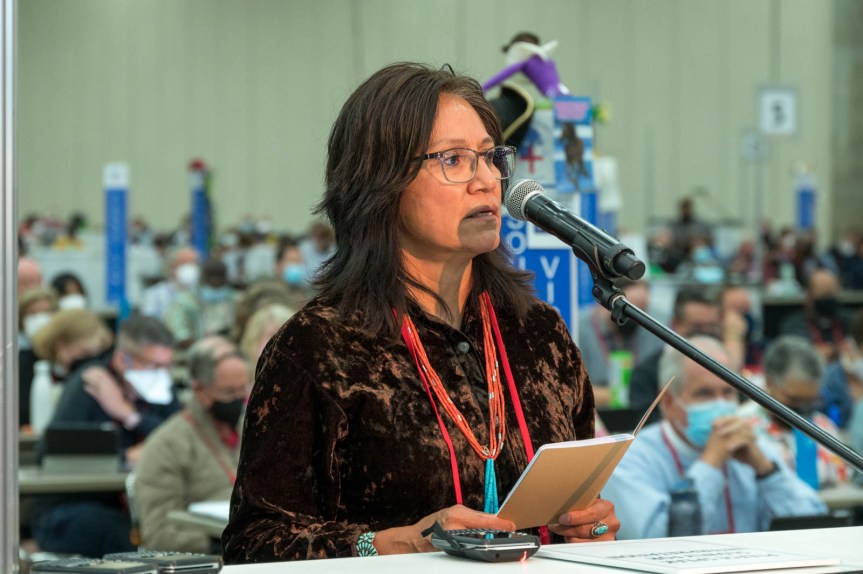
A127, Resolution for Telling the Truth about The Episcopal Church’s History with Indigenous Boarding Schools, unearthed deep pain. Indigenous Episcopalians approached the microphone and voiced powerful testimonies in favor of the truth-telling initiative; their stories were personal and vulnerable, rooted in multiple generations of trauma.
“My hell began at a boarding school in New Mexico,” said Deputy Ruth Johnson of Navajoland.
“[My father] knew his name only as number 89,” said Deputy Paul Williams of Alaska.
Such testimony is a painful gift to the church. These statements, given under the fluorescent lighting of an event space and the unrelenting gaze of microphone, cameras, and hundreds of delegates, have the potential to both catalyze change and re-traumatize the speaker. A127’s testimony was a powerful undertaking of vulnerability, travel, preparation, and spiritual labor.
We gather as a polity not only to conduct governance but to bear one another’s burdens. President of the House of Deputies Rev. Gay Clark Jennings made the pastoral decision to refrain invoking a typical mechanism to end debate after three testimonies in favor of a resolution seeing no dissent.
“There are some times when [legislative debates] are a time for holy listening,” said Rev. Jennings. “This was one of those times, in the Chair’s estimation.”
Lament and witness also erupted between legislative sessions at a spontaneous Bishops Against Gun Violence march responding to a nearby fatal shooting. More than 100 Episcopalians held vigil at the site of Timothy Reynolds’ death, praying for an end to systems of violence. It was a poignant reminder that our church is called to step outside our planned orders of business to pray, to lament, to serve.
The essential business of lament emerged throughout Day 1. Individuals approached the microphone to pray for St. Stephen’s Episcopal Church in Vestavia HIlls. Resolutions regarding racial justice, mental health, safe church resource translation, and disability called forth delegates with deeply personal, painful testimonies.
The Holy Spirit calls us to both lament and to hope. Our church has sins to reckon with: we have committed grave harm by what we have done and by what we have left undone. In holding space for lament, our polity conducts the essential business of loving God and our neighbor as ourselves. When a member of the church gives testimony, it becomes the testimony of the church; we are both “our neighbor” and “ourselves.” The essential business of lament, witness, repentance, and reparation cannot, and will not, end in Baltimore.
Featured photo:
“The Rev’d Canon Cornelia Eaton speaks”
Deputy Cornelia Eaton of Navajoland speaks in favor of resolution A127, “Resolution for Telling Truth about The Episcopal Church’s History with Indigenous Boarding Schools”
Photo credit Rev. Scott Gunn and Deputy News
 The Episcopal Herald